
Don't ask, don't tell
2026 August 1st

Back when Pontious was a Pilot, I was briefly in the Royal Air Force. My service was shorter than I hoped, and I did far more interesting things later as a civilian specialist working for the RAF than ever did whilst wearing a blue uniform, but I was there. When I was recruited, as you’d expect I went through selection tests, interviews and medicals. I remember at one of those interviews being asked my views on homosexuality, and it being made absolutely clear that homosexuality was totally incompatible with service in Her Majesty’s armed services.
Thankfully that outdated and bigoted viewpoint was firmly consigned to history within a decade of that. Around the same time, our American allies pursued a policy called “Don’t ask, don’t tell”, where it was fine to be a homosexual (or alphabet soup varieties thereof) so long as you never told anybody. So you could continue to serve your country, just as long as you stayed in the closet.
Over the last few years, as somebody with cancer, I’ve deliberately been extremely open about my status, my treatment, and how I was coping with my unwanted status. This blog is clearly a major part of that. That has led to an unexpected consequence, which is the number of conversations I’ve had that basically sum up to “how is yours going?” Now that should be absolutely fine - human beings naturally group together with others who have shared similar life experiences: I’ve loads of friends who are fellow aviators, fellow writers, fellow academics, and so-on. What’s not fine, is the extent to which I’ve realised that for a lot of these people I am one of a very small number of acquaintances they’ve told.
I’m not going to name anybody here, of-course. Secrets shared with me I hold sacred, at-least where I realise they’re a secret and they harm nobody else. But, I’m going to talk about a couple of disturbing examples.
There’s a professor I know but don’t work with. He has been living with prostate cancer for some years, and has engineered things so that nobody around him has any inkling that he has this burden in his life. It’s clear that he is seriously concerned that the university he works for will disadvantage his career if senior colleagues find out, and thus chooses to keep it secret. I’m glad that he felt that in me at-least, he had somebody with whom he could share that secret, and we’ve had some lengthy conversations about our shared issues. But, he really shouldn’t have to.
There’s a retired test pilot I have known for many years, who was diagnosed with prostate cancer a couple of years ago, and is still going through treatment. He’s retired, it really shouldn’t matter any more, but nonetheless he seems extremely reluctant to talk openly about it. He opened up to me when we were at a symposium together recently, but so far as I know, very few other colleagues know a thing.
There really seems to be a perception by many people that we’re in that territory of Don’t Ask, Don’t Tell. It’s important to them that they should keep their cancer secret, except from immediate family and fellow sufferers, and sometimes not even then.
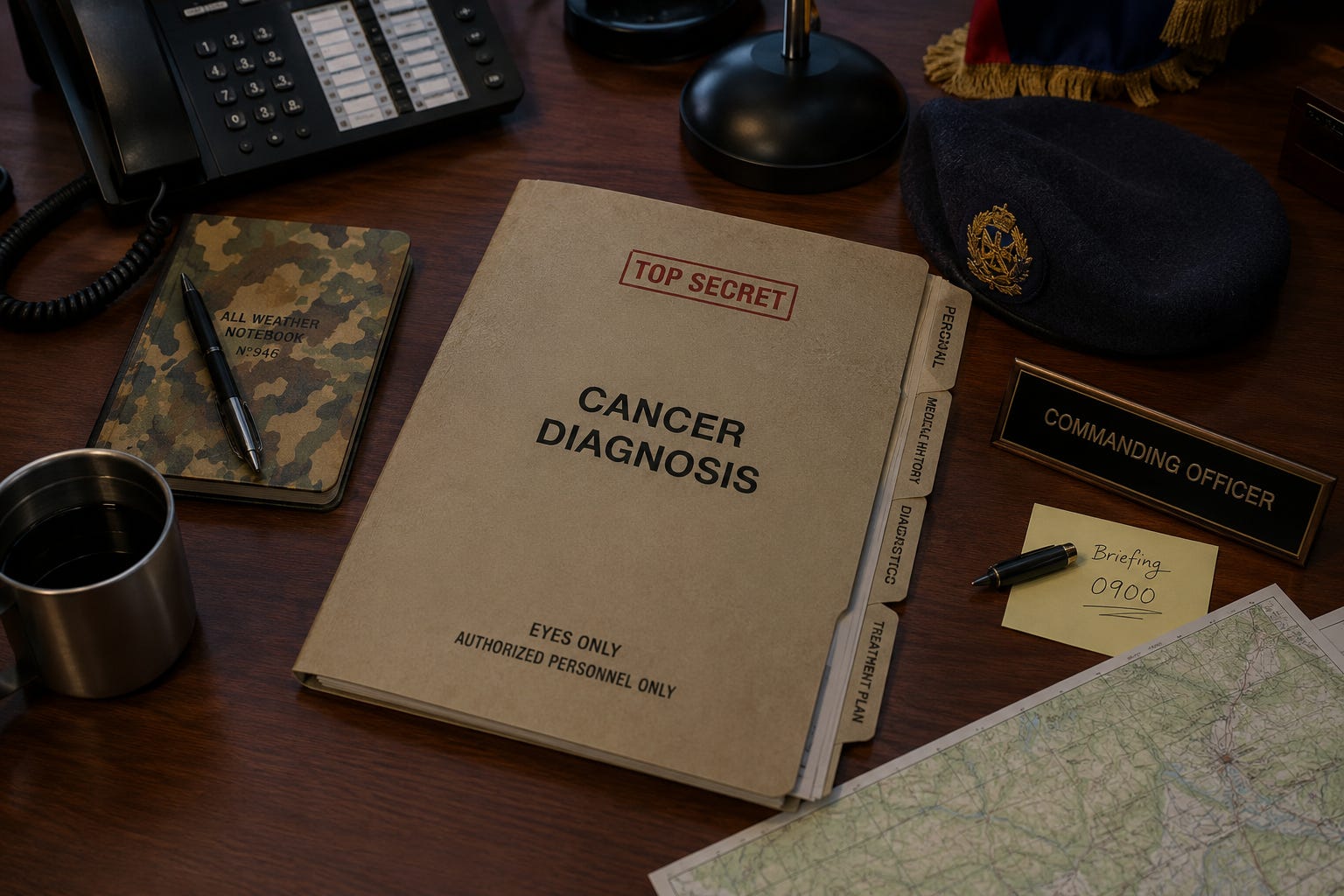
It almost feels like I’m developing a cancer “gaydar” (“cadar” perhaps?) where I sense that somebody has cancer, and might need the opportunity to confidentially chat about it. On one level I’m honoured that people feel they can trust me, and glad to be able to help somebody to share their worries and experiences with somebody who understands. And, of-course, I do understand. At the same time, it distresses me that we’re still in a world where so many people find this necessary.
But they do. It took me thirty seconds of googling to find images and statistics showing that globally there is a stigma associated with having cancer, in very many people’s minds. It took me a little longer to investigate the subtleties of that. It’s clear that a great many people with cancer do not feel that they can be public about it. They feel judged, perhaps some way inadequate, or they feel concerned about the impact public knowledge will have on them.
Here are a few breadowns I discovered in my reading around the subject:-
Prostate or Breast Cancer sufferers are concerned that because of the effects either the disease or the treatment will have on their bodies, they will be perceived as less masculine, or less feminine.
Lung, or head and neck, cancer sufferers, because of decades of anti-smoking campaigns, will feel judged as having brought it upon themselves.
Similarly with liver cancers and perceptions of alcoholism.
Cervical cancer sufferers worry about being judged for perceived sexual promiscuity.
This isn’t totally universal. Campaigns have reduced the stigma associated with either prostate or breast cancer, and it seems that in high income countries with good healthcare systems, things are a bit better than otherwise.
This all horrifies me. I know first hand that living with cancer, and going through cancer treatment is distressing and gruelling. My own experience has been largely positive - maybe one or two people have been avoiding me, maybe one or two people at work were insufficiently respectful of what I was going through, but the vast majority of people around me have been totally supportive. I have on the other hand been often described as brave for my openness about my cancer - something I really don’t perceive myself as being. But at the very least I’ve not been as afraid as some people clearly are to be open about my position. But these conversations, and these descriptions, show our society in very poor light that we can’t always uncritically support people we know with such a serious medical condition.
I wish I had a moral to this little essay, but I really don’t. I can only say that I can see aspects of our society here that is broken, and unhealthy. Perhaps we can all, whether we suffering ourselves or not, just try and quietly and supportively move it in a healthier direction.
(P.S. Do consider buying my first novel, details here.)
What you've written here needs to be said over and over and over again until any power left in negative views about cancer and people with cancer is flooded out by experience and understanding. That is the only way to shift these antiquated and ignorant beliefs. It is an underlying belief that we still give credence and power to, that having cancer is somehow a 'moral' issue, either because of habit or lifestyle, when we keep it secret. While some cancers might (I have to say 'might', because no one really knows) have their beginnings in behaviours, this is not always the case. Cancer lives in all of us, and then there is a 'trigger' that says 'stop responding to the brakes', and there it goes. Maybe that is where the reluctance to confront or the 'othering', lives, in the fear that 'that could be me'. They are right, of course; cancer could be something they experience. It is something many people face at some point in their lifetime. I hope for them that they find courage and resilience as you have shown. And honesty. Because again, that is the only way to change anything.
Slightly different, I know, but I was initially hesitant to be public and open about my Parkinson's diagnosis for many reasons. I'm glad that I chose to be open about it but it did cost me my job which was a scary time with 2 young kids to worry about.